October 12, 2026
The Room, Before Your First Hijama
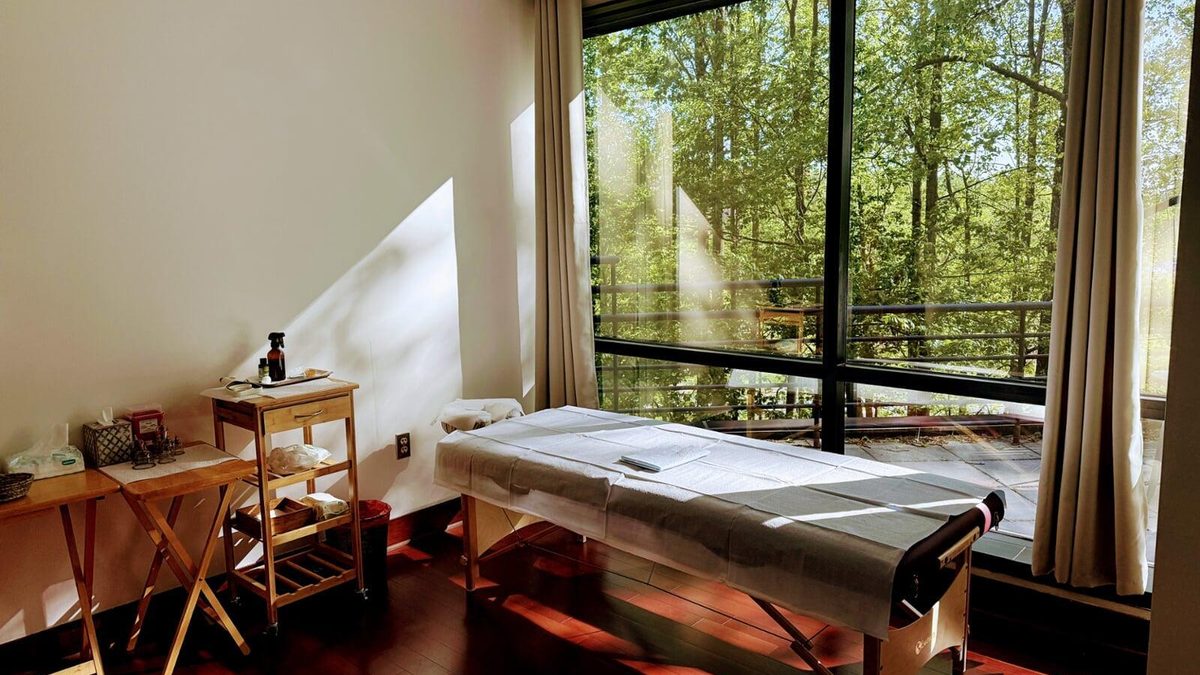
People put this off for longer than they mean to, and when they finally say why, it is almost never the scratch.
It is not knowing what they are walking into. A room they have never seen, a door they have never opened, and no picture anywhere of what is on the other side of it. That is a much easier thing to keep postponing than a few seconds of discomfort.
So this is the room.
The hijama clinic in Fairfax: what is actually in the room
One padded table with folded towels on it. A wooden trolley with the cups laid out. A small side table with a spray bottle and a tray. A wooden floor. A sharps container beside the trolley.
And a wall of glass running floor to ceiling onto trees, so the light in the room is daylight.
That is the inventory. There is not more.
What is not in it
No waiting room full of people who can guess why you are there. No white tiles. No strip lighting. Nothing with the particular shine of a procedure room.
People walk in expecting something clinical and are usually quiet for a second, because it is plainer and calmer than they had built it up to be. It looks like a room in a community building with a table in it, which is what it is.
One person at a time
The door is closed and you are the only person in the room. That is not a feature we arranged for a post; it is the only way a single room with a single table can work. But it is worth saying, because the mental picture people arrive with is often a row of tables with curtains between them.
The trolley, and why it is worth looking at
Everything for your session comes off that trolley, out of its packet, in front of you. The cup is new. In a wet cupping session the blade is new. Afterwards the blade goes into the sharps container next to the trolley and stays there.
You do not have to take any of that on trust, and you do not have to be polite about checking. Watching the packet open is the normal thing to do, not the suspicious thing.
The building around it
The room is on the fourth floor of the HAWA Fairfax Community Center at 4401 Fair Lakes Ct, in Fair Lakes. Room 401a. It is a low, dark-glass building set back behind trees, and the first time most people go looking for it they expect something more obvious.
Inside, it is a community building. Other things are happening in it. Nobody in the corridor knows what you are there for.
If you are new to this entirely
You do not need to know anything before you come.
Not the vocabulary, not the history, not what you are supposed to say. The intake conversation at the start covers what matters, in order, and questions are welcome at every point of it. People who are new to Islam sometimes assume there is an etiquette they are short of. There is not one you need for this.
The first ten minutes are: you sit down, you answer questions, nothing is opened until that is finished. Then the room, then the first cup, and what you feel first is suction.
Who you will see
A woman practitioner for sisters, a man for brothers. Separate calendars, separate windows, no arrangement to make and nothing to explain.
Brothers: every day, 12:00 to 13:30 and 14:00 to 15:30. Sisters: Tuesday to Thursday, 16:00 to 18:00, and Saturday and Sunday, 17:00 to 19:00. By appointment only.
What it costs and how long you are there
Wet cupping is $135 and dry cupping - suction only, no scratch - is $115. A $55 deposit holds your time when you book and comes off the price; the balance is paid after the session.
An hour and a half to two hours, door to door. Most of that is not the cups. It is the conversation first, then the session, then a few minutes of sitting and the aftercare notes. You drive yourself home.
Do not eat for two to three hours beforehand - water is fine - and come in a state of wudu.
Come and see it
That is the honest invitation. The room is the argument, and no description of it does what standing in it does.
Wet cupping $135, dry cupping $115, a $55 deposit holds the time. hikmahealing.art/appointments
Hijama is a traditional practice and is not a substitute for medical care. If you are on medication, pregnant, or unsure for any reason, speak to your doctor first and say so at intake.